Study on Benefits and Effects of Free Trade Agreements cited in Press
The lower house of the Swiss parliament rejected the EFTA economic partnership agreement with MERCOSUR in mid-June 2026 – agricultural, social and green interests combined had the majority. Our study shows that benefits of new FTAs increasingly have to be sought outside of the purely economic realm.
Study on Benefits and Effects of FTAs
Economic gains associated with additional Free Trade Agreements (FTAs) are increasingly limited (since most economies have already concluded FTAs with their most important economic partners a long time ago, while tariffs are generally low on average today – hence, remaining economic benefits are limited to begin with), and given that general awareness of negative effects of trade liberalisation has increased substantially, new FTAs have to be justified by more than mere economic gains, and they have to deliver on trade-related interests to secure ratification in industrialised countries. We explained this in a study commissioned by the Swiss social democratic parliamentary group on the benefits and effects of FTAs. Our study is the first application of the data collected in our Sinergia databases on impact assessments, trade-related obligations in FTAs and on domestic flanking policies. We show that there are economic, social and environmental risks associated with trade liberalisation, and we discuss can be reduced through international and domestic flanking measures and turned into benefits for the economy, but also for the environment and society. The study that also assesses economic benefits of regulatory and political stability achieved through FTAs is available here.
News and Co-authors
News article about the rejection of the EFTA-MERCOSUR Agreement – with a tiny reference to our study is available here.
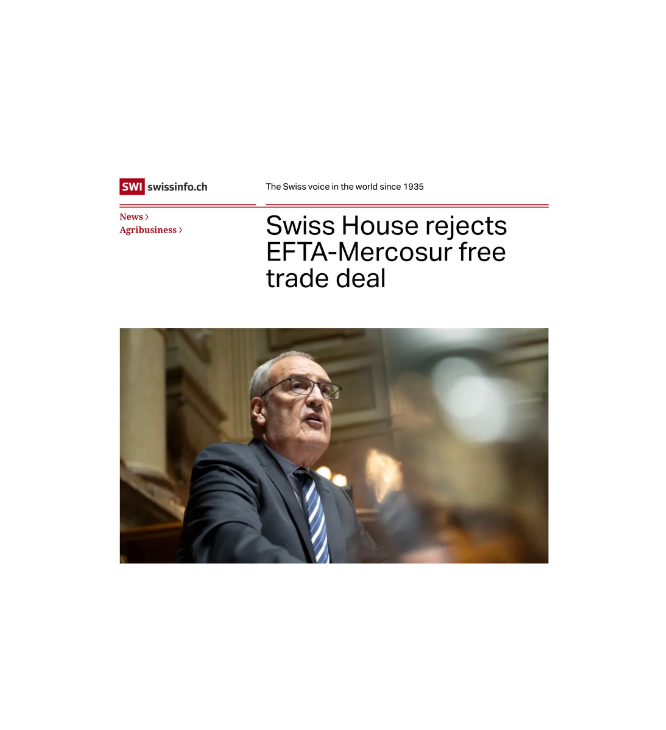
News article in English describing what happened in the lower house of the Swiss parliament is available here.
The study was conducted together with Noémie Laurens, Rohan Choudhary, Oliver Braunschweig, Cédric Dupont, Seraina Vonarburg and Nomcebisi Ndlovu